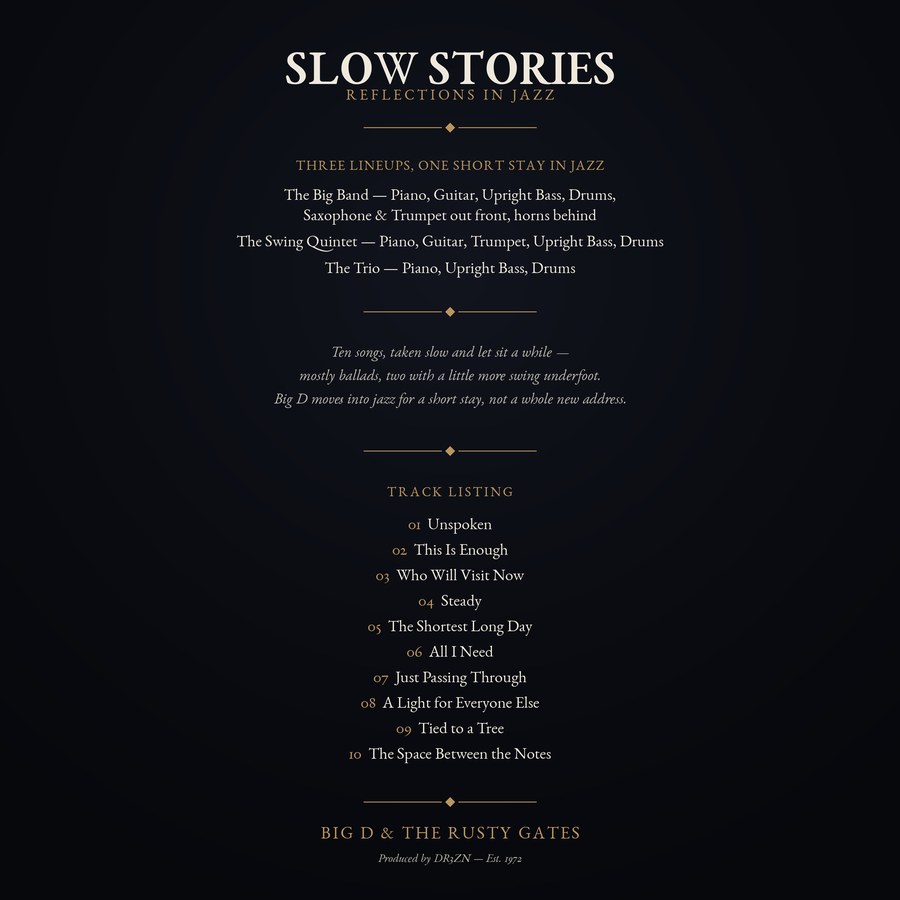
Nine Rusty Gates songs taken apart and put back together slow, plus one new one built around the quiet instead of the noise. Big D moves into jazz for a short stay, not a whole new address.
Big D found jazz the way he's found most things — by accident, in a room he wasn't supposed to be in.
It started on a dead night off The Unspoken Tour, when he wandered into a half-empty basement club just to get out of the rain and caught the back half of a trio's set that didn't seem to be going anywhere in particular — until it was. Pianist Desmond Reyes waved him up to sit in on an old blues number, slowed almost to a stop, and neither of them could quite let it go afterward. A few months later it had become a session, then an album: nine Rusty Gates songs taken apart and put back together slow, plus one new one built around the quiet instead of the noise.
Three lineups carried it. The Big Band — piano, guitar, upright bass, drums, saxophone and trumpet out front with horns behind — for the two songs that were never going to sit still. The Swing Quintet — piano, guitar, trumpet, upright bass, drums — for the songs that still wanted to move, just slower. And the Trio — piano, upright bass, drums — for everything that just wanted to sit in a chair and think.
Not a new direction for the band. A long layover.
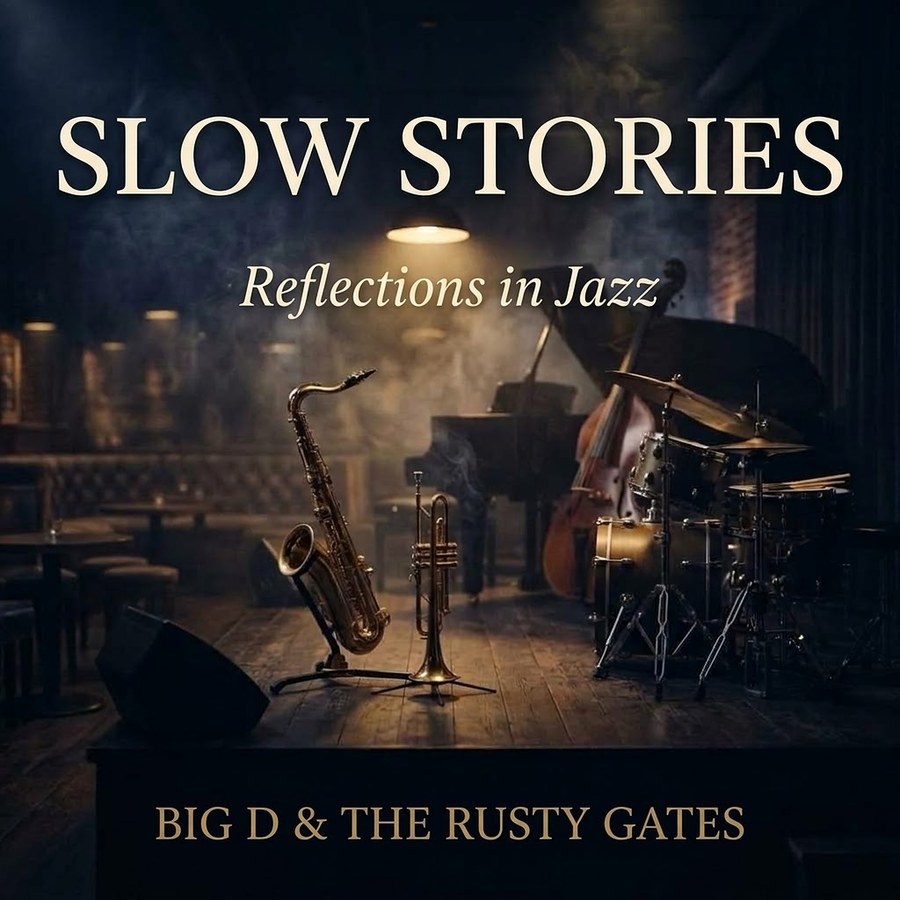
Track Listing
The Big Band: saxophone and trumpet out front, a small horn section behind. The jazz version keeps the song's old gravity — it just stops shouting to get there.
The Trio — piano, upright bass, drums. A song about contentment that finally sounds like it's sitting still.
The Swing Quintet, pulled all the way back to a near-whisper — proof the bigger lineup can sit just as still as the trio when a song asks for it.
The Trio, but one of the few songs on the album that still finds a mid-tempo — unhurried without fully stopping.
The Trio, stretched out. A song already about time dragging its feet, given all the room it asked for.
The Swing Quintet, warm rather than loud. Guitar and trumpet trade the lead instead of fighting over it.
The Swing Quintet keeps it moving without ever rushing — the one song on the album that still sounds like it's got somewhere to be.
The Big Band, the second and final time it appears on the album — saxophone and trumpet out front, giving a quiet title an unexpectedly full room.
The Trio closes out the original nine, piano carrying most of it — the song was never asking for more than that.
The one new song, written for the album rather than reimagined for it. Filed under the Swing Quintet, though it's really the Trio pared back further still, joined by a single trumpet playing alone and cracked at the edges — more a blues horn that wandered into the wrong room than a jazz one trying to fit in. About the quiet itself, and what's actually in it once the world stops asking where you'll be by noon.